

Introduction
Many children in Britain live with domestic abuse. The consequences can be wide-ranging, as well as exposing children to physical and emotional harm. They see parents or carers suffer, often at the hands of someone else they love. They can experience physical, sexual and emotional abuse themselves. Sometimes they are forced into colluding with the violent parent or carer; sometimes they feel deeply responsible for the non-abusing parent or carer, or their siblings. Some children experience domestic abuse from their own intimate partner.
Need more?
Thank you for visiting our resources pages. These are free to everyone as is our fortnightly safeguarding bulletin – general safeguarding information is too important to restrict. Become a member to access lots more, including training materials for you to deliver in-house on each topic in Keeping Children Safe in Education.
Sign up for FREE fortnightly bulletin.
What about training?
We can deliver training for your setting on this and other subjects via online platforms, or face-to-face in certain areas. Just get in touch to discuss your requirements.
The impact of violence and abuse can be devastating. Many people who experience domestic abuse suffer physical harm, which can be fatal in extreme cases. Death may result from violence or through suicide because the abuse and subsequent mental illness have made the target’s life difficult to bear. Other people subjected to domestic abuse may lose their homes, be unable to maintain a job or a relationship and/or become isolated from friends and family. Children may also be at risk, either by witnessing abuse of others or by being victims of abuse themselves.
Children can be further affected when parents or carers who have experienced domestic abuse sometimes find it difficult to be the caring, supportive parents they want to be, even after leaving the abusive relationship, because they have been hurt and traumatised by their experiences.
Definitions
Domestic abuse
Domestic abuse is any incident or pattern of incidents of controlling, coercive, threatening behaviour, violence or abuse between those aged 16 or over who are “personally connected” and the behaviour is abusive. Abuse can be direct or indirect (e.g., through a child). Children can be victims if they are related and see, hear or experience the abuse.
It can feature
Physical abuse
Sexual abuse
Violent or threatening behaviour
Controlling or coercive behaviour
Economic abuse
Psychological, emotional or other abuse
Adapted from the Domestic Abuse: Statutory Guidance
Teenage Relationship Abuse
Teenage relationship abuse is a pattern of harmful, abusive or controlling behaviour in an intimate relationship, very similar to as in domestic abuse. The abuse can happen face-to-face, online, or both.
Adapted from The Children’s Society
Child to parent (or care giver) abuse
Child to parent abuse (CPA) is where a child or adult-child uses harmful behaviours against their parents or caregivers beyond a single incident, however CPA is acknowledged in the Domestic Abuse Act 2021. This means that if the child is 16 years or over, the abuse falls under the statutory definition of domestic abuse, and it does not matter whether the CPA behaviour consists of a single incident or a course of conduct for it to be defined as domestic abuse.
Adapted from College of Policing
Domestic abuse - do you or someone you know need support?
If you or someone you know is in an emergency situation, call 999
Freephone 24 hour National Domestic Abuse Helplines -
England: 0808 200 0247
Northern Ireland: 0808 802 1414
Scotland: 0800 0271234
Wales: 0808 801 0800
Men's Advice Line (for men experiencing domestic abuse): 0808 801 0327
Respect helpline (for anyone worried that they may be harming someone else): 0808 802 4040
Calop (national helpline for lesbian, gay, bisexual and trans people experiencing domestic abuse): 0800 999 5428
Forced Marriage Unit: 0207 008 0151
Paladin - National Stalking Advocacy Service: 0203 866 4107
Domestic abuse is more than physical
Domestic abuse is not just physical violence, hence the move from talking about domestic violence to talking about domestic abuse. Many people experiencing violence report the psychological and emotional impact as having a greater impact, while others are manipulated and abused without physical violence. All of these experiences have an impact on children and young people.
Domestic abuse also falls within wider Violence Against Women and Girls (VAWG) and Adolescent to Parent Violence and Abuse (APVA) strategies.
According to the Royal College of Psychologists, in relationships where domestic abuse occurs, approximately three-quarters of the abusive incidents are witnessed by children. Around half of the children in these families have also experienced being badly hit or beaten themselves. Additionally, the likelihood of sexual abuse and emotional abuse occurring in these households is significantly higher.
Prevalence
The National Centre for Domestic Violence says 1-in-5 adults experience domestic abuse during their lifetime. This equates to 1-in-4 women and 1-in-6 or 7 men. They report that domestic abuse and sexual violence can be persistent with the highest repeat victimisation of any crime.
The Crime Survey for England and Wales found an estimated 2.2 million females (9.1%) and 1.5 million males (6.5%) experienced domestic abuse in the year ending March 2025.
SafeLives says 78% of children living with domestic abuse are directly harmed by the perpetrator of the abuse, in addition to the harm caused by witnessing the abuse of others.
Department for Education (DfE) statistics on the characteristics of children in need found that concerns about the mental health of the child's parent/carer and the child’s parent/carer being the victim of domestic abuse remained the most common factors identified in completed assessments in year end March 2025.
Domestic abuse is often a hidden harm
We know that there is a high degree of under-reporting from both males and females, the National Centre for Domestic Violence suggests that less than 20% of victim-survivors report to police. This means that accurate figures are likely to be significantly higher.
Under-reporting can be linked to different factors, including shame, blaming themselves for their partner’s behaviour and believing that it is an inherent part of the relationship. Sexism might also be a factor and whilst it would be too simplistic to say there was a direct cause and effect between sexism and domestic abuse, sexist attitudes can contribute to unhealthy and unequal power dynamics within relationships.
Sexism can normalise the objectification of others, sexual entitlement and beliefs that someone's boundaries matter less because of their sex or gender. These attitudes can contribute to sexual harassment, coercion and sexual violence, including harmful sexual behaviour between children and young people.
Domestic abuse often gets worse over time, and many victim-survivors are manipulated into believing that they are at fault. It may also be that they:
don’t yet recognise the abusive nature of the relationship
don’t think they will be believed (many domestic abusers appear loving and charming to others, and/or they may be in professions linked to protection or status)
are too scared to leave
don’t have money or anywhere else to go
feel isolated
face a language/communication barrier
struggle with pressures from their religious/rural/close community or family
feel dependent due to age or disability
may not wish to risk their immigration status
worry about taking their children out of school and moving them
no longer have the strength to leave and fear the upheaval it may cause for them and/or others
believe/hope they can change things
hope that the abuse will stop
feel or experience that support services are not readily available for their individual needs.
Domestic Abuse & Violence Online Training Course
Ensure all staff understand and can apply the wider definition of domestic abuse. We offer a challenging e-learning package that is relevant to anyone working in education for £30 + VAT per person (£15 + VAT per person for Safeguarding Network members).
Impact on children and young people
Domestic abuse can affect children even when they are not directly harmed or do not appear to be aware of what is happening. Living with fear, control, intimidation or violence can have a significant impact on a child’s safety, wellbeing and development.
Mental health - Children exposed to domestic abuse often experience intense feelings of fear, anxiety, and helplessness. This can lead to symptoms of post-traumatic stress disorder (PTSD), depression and anxiety. They may also struggle with mood swings, sleep disturbances and issues with self-esteem and self-worth.
Social development - Many children may struggle to form healthy relationships and trust others because their understanding of interpersonal relationships has been shaped by dysfunction and violence. This may include displaying aggressive, antisocial or defence behaviours, due to internalising the violent dynamics they have witnessed.
Academic performance - The stress and trauma associated with domestic abuse can impair a child's ability to concentrate, problem-solve and learn. This can lead to long-term educational challenges and hinder their prospects.
Higher risk of other forms of harm both now and in the future - Children who have been exposed to domestic abuse can be at a higher risk of of other forms of harm both now and in the future. This might be in relation to enacting or being subjected to domestic abuse or there might be other forms of harm which arise for them.
Signs of domestic abuse
Children or young people may:
be wary of adults
be aggressive, act out witnessed events
have difficulty concentrating
have difficulty developing relationships
reduce attendance at education and/or attainment
develop an eating disorder
have poor self-esteem, depression or anxiety
self-harm
develop concerning relationships.
What to do
Create a culture based on equality and informed choice. Settings are well placed to help by:
Teaching children about relationships through the relationships and sex education (RSE) and health education curriculum and also through a wider promotion of equality across the setting, including equality in same-sex relationships. This links closely with education about bullying.
Creating discussions and opportunities to reflect on developing relationships between young people.
Raising awareness of domestic abuse among students, staff and parents and carers. Ensure everyone knows who to talk to if they are worried or believe they or someone they know needs help.
Check children and young people have safe relationships – in their family, with their peers and with your staff. Create a culture where it’s okay to talk even about the most difficult things.
Know the signs of potential harm and know what to do – use the checklists above, your safeguarding procedures and be confident in raising domestic abuse as a concern.
Take action – and keep taking action until you know children and young people are safe. If there is an immediate risk of harm to anyone, call the police.
Building partnerships with parents and carers
When working with parents and carers, practitioners should prioritise a child-centred approach, fostering partnerships to ensure understanding, support and safety.
Remember:
Collaborative efforts are crucial, especially in cases of suspected harm.
Practitioners must engage effectively with diverse families, demonstrating empathy, respect and cultural awareness.
Communication should be clear, inclusive and accessible. Encouraging parental/carer involvement in decision-making and valuing their input is essential.
Involving families and communities in designing processes fosters a holistic approach to safeguarding children.
Continuous reflection and adaptation based on feedback from parents and carers enhance practice effectiveness.
Have you considered if:
* parents and carers need more support to understand and trust the role of the police and other services?
* there are enough places and spaces where parents and carers from marginalised groups can seek informal advice and support from the setting?
* the signposting and information regarding domestic abuse and support services are accessible to all families, with consideration given to language, literacy, learning needs? Could this information be accessed very discretely if someone needed to do so?
Free domestic abuse poster
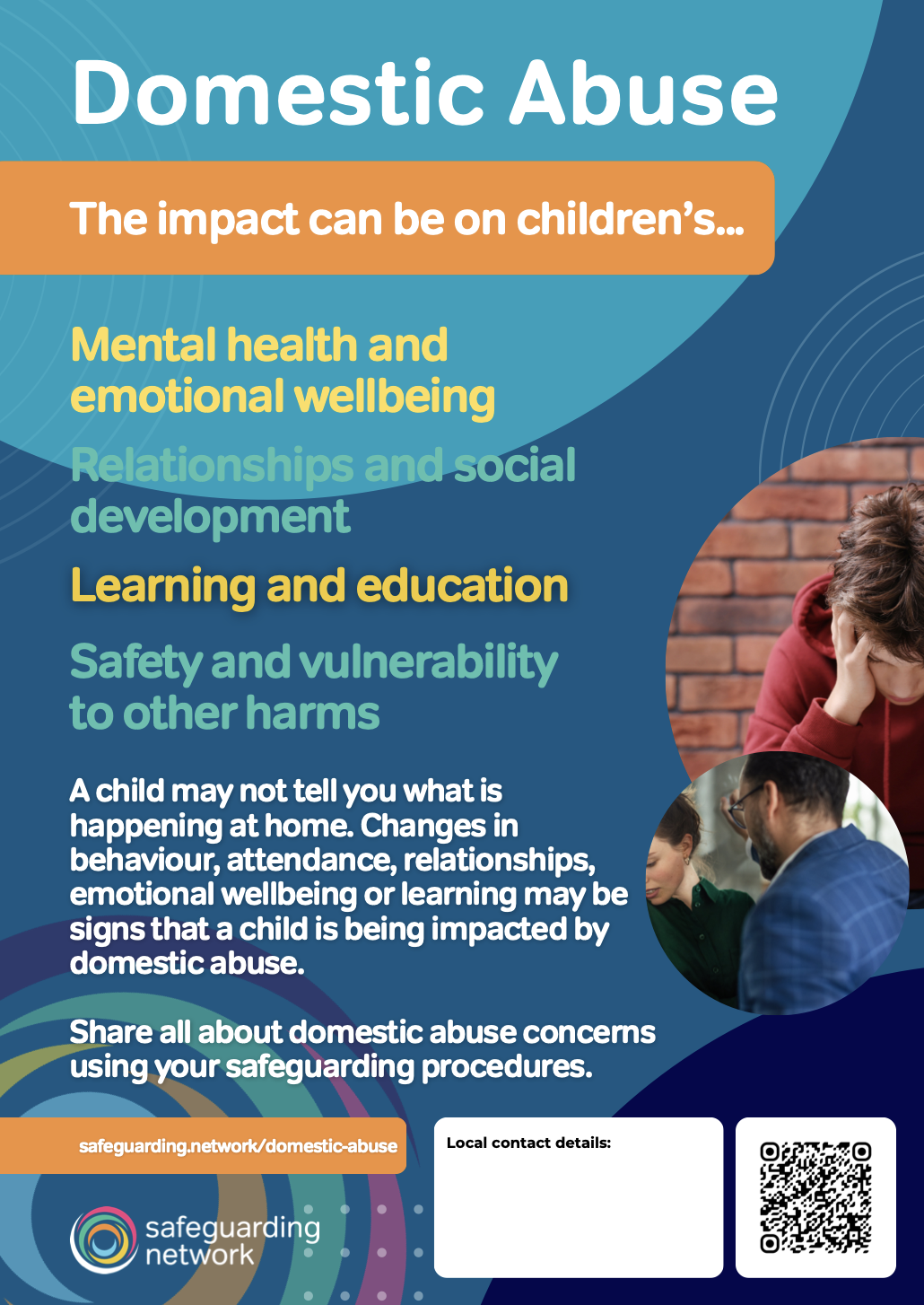
This free, downloadable resource raises the profile of safeguarding for your staff team. For use in staff rooms, on safeguarding boards or on the back of toilet doors, the poster includes tips, a space for local contact details, plus a link and QR codes to this resource page. Download the poster from the resources below.
DSL Training Materials
-

Presentation: Domestic abuse
-
Domestic Abuse - Presenter Notes
-

Expect Respect Healthy Relationships Toolkit
-
Handout for staff - Domestic Abuse
-
Introduction to Domestic Abuse e-learning
-
Domestic Abuse – Quiz
-
Domestic Abuse – Quiz (answers)
-
Domestic Abuse Scenario – Early years settings
-
Domestic Abuse Scenario – Early Years settings – DSL Information Sheet
-
Domestic abuse scenario (primary schools)
-
Domestic abuse scenario (primary schools) – DSL information sheet
-
Domestic abuse scenario (secondary schools)
-
Domestic abuse scenario (secondary schools) – DSL information sheet
-
Domestic Abuse Scenario – 16+ settings
-
Domestic Abuse Scenario – 16+ settings – DSL Information Sheet
-
Domestic Abuse Scenario – SEND Settings
-
Domestic Abuse Scenario – SEND Settings – DSL Information Sheet
-
Domestic Abuse Scenario – care settings
-
Domestic Abuse Scenario – Care settings – DSL Information Sheet
Resources
-
Domestic Abuse Poster
-
Women’s Aid – downloads and resources
-
Children and young people Insights dataset
-
Operation Encompass
-
Introduction to Domestic Abuse e-learning
-
Coercive control: ‘I was 16 and thought it was normal’ – BBC video
-
CPV – Child to Parent Violence
-
Teen violence and abuse at home – Family Lives
-
Spotlight: The podcast for the domestic abuse sector
-
For Baby’s Sake
Save time and improve your safeguarding approach…
Bite-size training materials to share with your staff every month.
Support to explore and develop your safeguarding culture.
A huge array of resources and professional experience at your fingertips.
Get in touch now for a personal tour of the site and details of membership benefits.
We look forward to working with you.