

Introduction
The exploitation of children and adults can sometimes include modern slavery and or trafficking. Modern slavery is a serious crime where victims are controlled and sometimes threatened, abused and held captive. Perpetrators of modern slavery might use violence or threats of violence as part of their control, but not always. Trafficking is when a trafficker organises someone’s travel into, out of, or within the UK for the purposes of exploiting them.
Slavery as a general term is when someone behaves as if they ‘own’ another person and has intense control over them and their lives. Slavery might occur in any context and can occur in any relationship - perpetrators can be partners, family members or someone else in the victim’s network. Trafficking does not necessarily involve travel to another country or even long distance nationally. A child can be trafficked within their local area, especially for child sexual exploitation and child criminal exploitation. Exploitation can also include forced labour, domestic servitude, or the removal of a person’s organs.
Need more?
Thank you for visiting our resources pages. These are free to everyone as is our fortnightly safeguarding bulletin – general safeguarding information is too important to restrict. Become a member to access lots more, including training materials for you to deliver in-house on each topic in Keeping Children Safe in Education.
Sign up for FREE fortnightly bulletin.
What about training?
We can deliver training for your setting on this and other subjects via online platforms, or face-to-face in certain areas. Just get in touch to discuss your requirements.
It is important to remember that anyone who is experiencing of any form of modern slavery and or trafficking is likely being exploited and harmed in more than one way and that many of the forms of harm overlap. It is highly likely that victims go without access to essential services and that they miss out on opportunities, education and family and community connections. The negative consequences are often profound and long-lasting.
Some trafficked children and victims of modern slavery are hiding in plain sight, while others are never seen. To safeguard children from modern slavery and trafficking requires a multi-agency response that includes education settings, community groups, members of the public, health services and the police.
A note on language used – some people who have experienced modern slavery and or trafficking prefer to be referred to as survivors, rather than victims. It is important for people who have experienced abuse to be able to define themselves in any way which feels comfortable to them and does not lead to further victimisation. That considered, we are discussing harm to children here and we have referred to those who have experienced modern slavery and or trafficking as victims because we feel this appropriately reflects a child’s need for adult protection.
Definition of modern slavery
“An umbrella term for activities involved when one person obtains or holds another person in slavery or servitude, or requires another person to perform forced or compulsory labour.”
Adapted from the Modern Slavery Act, 2015
Definition of human trafficking
“Human Trafficking is the recruitment, transportation, transfer, harbouring or receipt of people through force, fraud or deception, with the aim of exploiting them for profit.”
Prevalence
The number of referrals to the National Referral Mechanism (which assesses potential victims of slavery and provides support to victims) have almost doubled in the last five years from 12,691 referrals in 2021 to 23,411 in 2025. This is the highest ever number.
The annual assessment for Unseen’s Modern Slavery and Exploitation Helpline in 2025 found:
A total of 2,954 cases of modern slavery were reported involving 6,628 potential victims.
There were 41% more cases of modern slavery reported than in the previous year.
In general, labour exploitation remains the most prevalent exploitation type, followed by sexual exploitation, criminal exploitation, and domestic servitude.
Aspects of modern slavery and trafficking
Forced labour - any type of work, legal or illegal, a victim is forced to do against their will. Exploiters might trick their victims by promising well-paid work and good accommodation. Victims are forced to work long hours for little or no pay and are often made to live in poor conditions. It can still be modern slavery if the victim is kept in decent conditions but is forced to work.
Sexual exploitation - we know that adults with the capacity to consent are able to make choices regarding the work they do – however, some people are exploited within the sex work industry. Types of sex work include brothels, saunas, massage parlours, webcams, sex chat rooms, escort agencies and lap dancing. Sexual exploitation might also relate to other forms of sexual activity outside of the sex work industry, for example children can be manipulated or coerced into creating child sexual abuse imagery. The ‘boyfriend’ or ‘friend’ model of coercion features the victim being led to believe that their abuser is their friend or romantic partner. The victim might believe they are consenting to sexual acts, but the relationship is also controlling and abusive.
Domestic servitude – often the victim will be made to live on the exploiter’s property and is forced to do things for their exploiter such cleaning, cooking and looking after children. They cannot change their circumstances because they might not have any money, a passport or other way of escaping.
Organ harvesting – a form of exploitation in which victims have internal body parts removed. Victims often appear to have consented to the removal of their organs, but their consent is invalid when deception, fraud or abuse of a position of vulnerability is involved. Exploiters profit by selling these organs to recipients who are unable or unwilling to wait for legal transplants. The most harvested organs from victims are kidneys, followed by parts of livers.
Financial exploitation - money laundering by coercing or manipulating someone into moving money through their accounts. It can also involve children being pressured into opening a account which is then controlled by the exploiter.
Forced cannabis cultivation - victims are held in a property against their will and forced to tend to cannabis plants. This is more likely to affect older children and adults, including those who have been trafficked into the country. If anything happens to damage the cannabis crop, the victim is blamed and may be forced into debt bondage (see below).
Debt bondage - a form of entrapment which occurs when someone owes money to exploiters and is made to do tasks or ‘favours’, such as provide free labour, enact violence, steal, move items, store items and/or sell drugs.
Forced marriage - a forced marriage happens when someone (male or female) is faced with physical or emotional pressure to marry. The force may include threats of/actual physical or sexual violence, financial abuse (e.g., the taking away of someone’s wages) and/or the individual being made to feel they are bringing ‘shame’ on the family by refusing to marry. Forced marriage is illegal in the UK.
County lines model of drug supply - drug networks use children and young people to carry out illegal activity on their behalf. The term originates from the use of dedicated mobile phone lines or other form of “deal line” to sell drugs from cities out to suburban and rural areas.
Additional vulnerabilities
Anyone can be vulnerable to modern slavery and/or being trafficked, however, there are some children that we know are more likely to become victims of this abuse than others, including:
child refugees and children who have migrated;
children who are not in the care of their parents/legal guardians;
those with links to criminal exploitation;
those missing from home and/or education;
excluded children;
those who are economically vulnerable;
those who are homeless or in insecure accommodation;
children living with substance misuse.
Spot the signs
Many of the signs are like those we see with any abusive situation; however, some specific considerations relate to children who:
are in situations where you do not know who holds parental responsibility (see also private fostering);
have unbelievable or surprising accounts of how they are in the country or area;
have parents working without pay;
are involved in inappropriate work for their age and stage of development;
display multiple or repeated injuries;
have tattoos or other marks indicating ‘ownership’;
distrust authority;
show recurring symptoms of poor physical, sexual and emotional health;
display any indicators of child exploitation occurring.
are not registered with a school or a GP practice;
do not have any documents (or have falsified documents);
stay out overnight with no explanation;
are seen getting into unknown cars or taxis;
experience a breakdown of Care placements;
have money or goods, including mobile phones, drugs and alcohol, that they cannot account for;
experience multiple sexually transmitted infections, miscarriages or terminations;
are self-harming;
are known or thought be involved in criminal activity;
spend lots of time doing household chores, rarely leave their house, and have no time for play.
Whilst we are considering child safeguarding here, it is important to remember that modern slavery and trafficking are forms of abuse which can affect adults too. It might be that the adults in the families of the children you are working with are victims of modern slavery and or trafficking and, if so, this might well have safeguarding implications for the children you are working with. It is important to always be curious about any signs or indicators which might be present for the adults in the family too.
Verbal Reports from Victims
The lack of a verbal report should not stop you considering modern slavery and or trafficking as a possibility. Victims might not recognise themselves as having been trafficked, exploited or enslaved.
Modern slavery and trafficking are multi-layered issues where more than one form of harm can be occurring at the same time. Victims might struggle to put their experiences into words.
Some victims tell confused stories with obvious errors. It is not uncommon for perpetrators to provide stories for victims to tell if they are approached by the authorities. Errors or unrealistic stories may be because they have had to memorise false histories that have been composed by others.
Victims may have been told they will not be believed, threatened by the perpetrator as part of the grooming process or told that they are to blame for the situation and that professional services cannot be trusted or help them.
What to do
Know the safeguarding processes in your setting - modern slavery and the trafficking of children is child abuse, therefore normal child protection procedures apply.
Be aware of additional vulnerabilities – are there children at your setting who may be particularly vulnerable to modern slavery, trafficking or any other form of exploitation? Could they benefit from early intervention? Share information at an early stage about any concerns.
Consider the child’s lived experiences - build and use your relationships with children and young people to understand what’s happening in their community (in school, locally and online).
Listen to/observe the ‘voice’ of the child - children and young people often find it difficult to speak about their experiences – what is their behaviour trying to tell you? Work with them to build trust and be a safe person for them to come to when needed.
Avoid victim-blaming language that can deflect attention from and down-play the experiences of victims leading to lack of confidence in reporting and broken trust.
Don’t make assumptions about the level of independence or control a child or young person has simply by the way they present themselves to you and others.
Work closely with parents and families, in agreement with your safeguarding lead, and where it’s appropriate, work closely with families to understand and reduce the risk.
Know the signs and know what to do – use the checklists above, your safeguarding procedures and be confident in raising trafficking and modern slavery concerns with your designated safeguarding lead. Settings should refer to children’s services or the police, which are ‘first responder’ organisations and should follow the National Referral Mechanism guidance to assess the next steps.
Take action – and keep taking action until you know children and young people are safe.
Building partnerships with parents and carers
When working with parents and carers, practitioners should prioritise a child-centred approach, fostering partnerships to ensure understanding, support and safety.
Remember:
Collaborative efforts are crucial, especially in cases of suspected harm.
Practitioners must engage effectively with diverse families, demonstrating empathy, respect and cultural awareness.
Communication should be clear, inclusive and accessible. Encouraging parental/carer involvement in decision-making and valuing their input is essential.
Involving families and communities in designing processes fosters a holistic approach to safeguarding children.
Continuous reflection and adaptation based on feedback from parents and carers enhance practice effectiveness.
Have you considered if:
parents and carers need more support to understand and trust the role of the police and other services?
the parents/carers of those students who are impacted by any form of exploitation are always offered the space to discuss their and their child’s needs and any support which they might benefit from?
the setting-to-home communication about exploitation and any local community risk issues are accurate and accessible to all parents and carers, with consideration given to things like literacy, language and disability?
Free modern slavery and trafficking poster
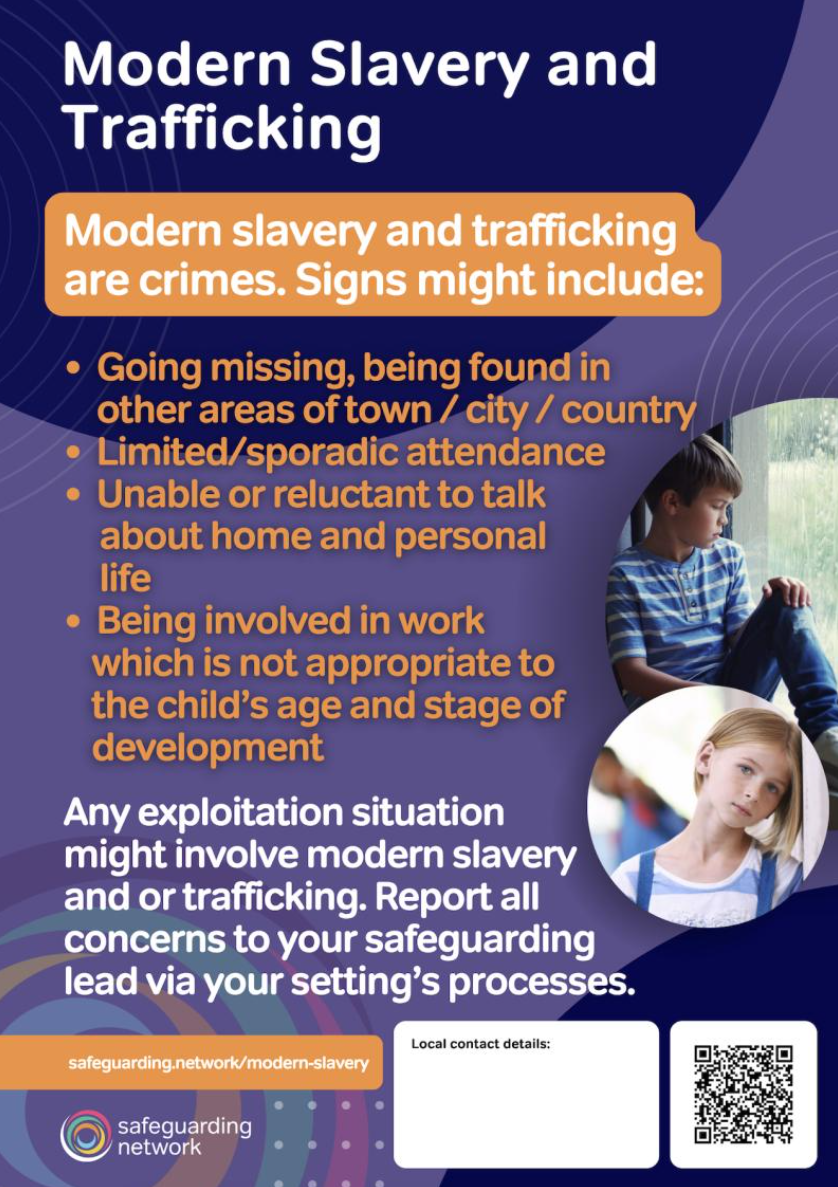
This free, downloadable resource raises the profile of safeguarding for your staff team. For use in staff rooms, on safeguarding boards or on the back of toilet doors, the poster includes tips, a space for local contact details, plus a link and QR codes to this resource page. Find it in the resources section below.
DSL Training Materials
-

Modern Slavery Presentation
-
Modern Slavery - Presenter Notes
-
Handout for staff - Modern Slavery
-
Modern Slavery Quiz
-
Modern slavery – Quiz (Answer Sheet)
-
Modern slavery scenario – EYFS
-
Modern slavery scenario (EYFS) – DSL Information sheet
-
Modern slavery scenario – Primary school
-
Modern slavery scenario (primary) – DSL Information sheet
-
Modern slavery scenario – Secondary Schools
-
Modern slavery scenario (secondary) – DSL Information sheet
-
Modern Slavery Scenario – 16+ / FE settings – DSL Information Sheet
-
Modern Slavery Scenario – 16+ / FE settings
-
Modern slavery scenario – SEND focus
-
Modern slavery scenario (SEND focus) – DSL Information sheet
-
Modern slavery scenario – Care Settings
-
Modern slavery scenario (care settings) – DSL Information sheet
Resources
-
Modern slavery & trafficking poster
-

ECPAT UK – useful tools
-
Prevention and identification of children and young adults experiencing, or at risk of, modern slavery in the UK
-
SAVE ME film and facilitator handbook
-
About Modern Slavery
-
Modern slavery is closer than you think
-
Modern Slavery & Exploitation Helpline website
-
Modern slavery awareness and victim identification guidance
-
The Independent Anti-Slavery Commissioner Reports and Publications
-
Care of unaccompanied migrant children and child victims of modern slavery - Statutory Guidance
-
The Passage Modern Slavery Toolkit
-
Modern Slavery Act 2015 – Statutory Guidance for England and Wales
-
Video Resources from the Fair Work Agency
-
Modern slavery training: resource page
Save time and improve your safeguarding approach…
Bite-size training materials to share with your staff every month.
Support to explore and develop your safeguarding culture.
A huge array of resources and professional experience at your fingertips.
Get in touch now for a personal tour of the site and details of membership benefits.
We look forward to working with you.