

Introduction
Allergy safety is an important responsibility for schools and other education settings. New statutory guidance for schools in England, published in July 2026, sets out expectations for supporting pupils with allergies, including allergy safety policies, staff training, Individual Healthcare Plans (IHPs), emergency responses and learning from serious incidents and near misses.
Ensuring the safety and wellbeing of those in your care includes being prepared for the unexpected. Serious allergic reactions can affect anyone, including individuals with no previous history of allergies. By understanding how to recognise the signs and symptoms of allergic reactions and anaphylaxis, staff in educational and childcare settings can react confidently, in a timely manner, and potentially save a life.
Need more?
Thank you for visiting our resources pages. These are free to everyone as is our fortnightly safeguarding bulletin – general safeguarding information is too important to restrict. Become a member to access lots more, including training materials for you to deliver in-house on each topic in Keeping Children Safe in Education.
Sign up for FREE fortnightly bulletin.
What about training?
We can deliver training for your setting on this and other subjects via online platforms, or face-to-face in certain areas. Just get in touch to discuss your requirements.
What is an allergy?
An allergy is where the immune system overreacts to a food or substance that is usually harmless.
Allergies can develop at any age and to a wide range of foods or substances. Reactions can vary from mild to severe (anaphylaxis) and symptoms can also differ due to a number of factors.
During a reaction, the immune response is to release chemicals such as histamine. It is the release of these chemicals that cause the allergic symptoms. These may include:
Swelling of the eyes, lips or face
Nausea or vomiting
Itching on the body, tingling in the mouth
Urticaria (hives) anywhere on the body
Mild throat tightness
Sudden behavioural changes
What is Anaphylaxis?
Anaphylaxis (pronounced ana–fil-ax-is) is a life-threatening allergic reaction that usually occurs suddenly - but can be delayed for up to two to three hours - and requires immediate treatment.
Anaphylaxis can happen when the body reacts to something it’s allergic to, releasing chemicals such as histamine in response. It is the release of these chemicals that cause the allergic symptoms.
Studies suggest between 5-8% of children are living with an allergy and 20% of allergic reactions happen at school, with a significant number of these being in students with no known allergy. With that in mind, it is critical for schools and other educational settings to have robust allergy management systems in place.
What are the signs of anaphylaxis?
ABC Symptoms
Most health professionals consider an allergic reaction to be anaphylaxis when it involves difficulty breathing or affects the heart rhythm or blood pressure. Any one or more of the following symptoms may be present – these are often referred to as the ‘ABC’ symptoms.’
A is for Airway - Swelling in the throat, tongue or upper airways, hoarse voice, difficulty swallowing
B is for Breathing - Sudden onset wheezing, breathing difficulty, noisy breathing, persistent cough
C is for Circulation - Dizziness, feeling faint, sudden sleepiness, confusion, pale clammy skin, loss of consciousness or collapse
REMEMBER - If any one of these symptoms are present, administer an adrenaline device - don’t delay.
See Anaphylaxis UK’s factsheets for detailed information on anaphylaxis and adrenaline.
What is Benedict's Law?
Benedict’s Law has been named after Benedict Blythe who died a preventable death on 1st December 2021 whilst in school.
Benedict’s Law is an amendment to the Children Wellbeing and Schools Act 2026 which came into force on the 1st September 2026. Benedict’s Law (s34 of the Children Wellbeing and Schools Act 2026) requires every school to have:
an allergy safety policy.
training for all staff.
spare adrenaline auto-injectors.
Benedict’s Law applies to all education settings, whether they are maintained, academy or independent.
For details about how the law has come about visit the Benedict Blythe Foundation website.
Visit Anaphylaxis UK’s dedicated Benedict Law guidance page.
Benedict's Law Training: Allergy Awareness in Schools
Every school in England has a legal duty to keep pupils with allergies safe, known as Benedict’s Law, part of the Children’s Wellbeing and Schools Act 2026. This course, run by Virtual College by Netex, helps every member of staff understand what that means in practice.
Allergy safety is now a mandatory, whole-school responsibility and sits alongside existing safeguarding and health and safety duties. Everyone working in a school must be trained in allergy safety, it’s not just for first aiders or medical staff.
This course gives everyone working in a school a clear, introduction to allergies and anaphylaxis, how to recognise the signs of a reaction and respond quickly, and what their own responsibilities are under their school's allergy policy. It uses plain language and assumes no previous medical or first aid knowledge.
Allergy safety in education settings
During Benedict Blythe's inquest, the Department for Education committed to updating the statutory guidance for schools that was first published in 2015 and updated in 2017 to include the ability for schools to hold spare adrenaline auto-injectors.
That update has culminated in the publication of the statutory guidance, Allergy Safety in Schools 2026. This applies to:
governing bodies of LA-maintained schools, including special schools, with specified exclusions;
PRU management committees; and
academy proprietors, including free schools and alternative provision academies, with specified exclusions.
Allergy Safety in Schools and Benedict’s Law are intertwined. Allergy Safety in Schools explains what has to be included in the allergy safety policy and what has to be included in the training. Allergy Safety in Schools goes further than Benedict’s Law and requires schools to:
have an allergy lead who is a member of the senior leadership team.
adapt the curriculum to ensure that students are fully included in the life of the school.
practice emergency response sometimes known as a drill.
be recording and reporting allergy incidents and near misses.
be monitored by the governing body as part of their regulatory duties with it being Have good practice to appoint a governor with responsibility for allergy.
Culture
Schools are expected to take a proactive approach to managing allergy with training being seen as only one part of good management practices. Implemented by the Allergy Lead, the school policy, available on the school website, will be clear in its detail about how the safety measures will be implemented. Staff need to understand this policy and be able to fully implement it. The implementation of the policy will be inspected by Ofsted during the safeguarding part of the inspection.
A key part of developing a culture of positive allergy management is the inclusion of allergy awareness for students who attend the school. At an appropriate level, students need to have regular teaching about what allergies are, how to keep others safe, why they need this support and the impact of living with allergies.
Each year there are opportunities to raise awareness of allergy by participating in Anaphylaxis Awareness Week in October and Allergy Awareness Week in April. To support this awareness, there are downloadable assemblies for staff to use.
Training
Allergy Safety in Schools 2026 is clear that staff training must include:
Have an awareness of allergy, the risks it poses, how allergic reactions can occur and how to manage it;
Understand that allergy includes multiple conditions (food allergy, asthma, eczema, hay fever, others), which can co-exist;
Understand the difference between food allergy, coeliac disease and food intolerance;
Know where to find information on allergy triggers;
Can identify the range of symptoms of allergic reactions;
Understand and can recognise anaphylaxis;
Know how to respond in an emergency, including:
calling emergency services and informing parents;
how to locate and administer emergency medication (adrenaline for anaphylaxis, asthma reliever inhaler for an asthma attack).
training on how to use the medication/device in an emergency (whether prescribed to a given person or a school’s “spare” adrenaline devices);
Understand the impact allergy can have on a child or young person’s wellbeing;
Understand the school, college or setting’s allergy safety policy; Know how to check whether an individual is on the record of those with known allergy and how to use an Allergy or Asthma Action Plan;
Understand their responsibilities in reducing the risk of individuals with known allergy coming into contact with their known allergens;
Understand how to report an allergic reaction or case of anaphylaxis (whether an incident or a “near miss”).
Schools are responsible for training every member of staff who is employed by the school regardless of how frequently they have or may have contact with the student. Schools are required to make arrangements to include training for new staff during their induction. Schools are responsible for ensuring that those contracted to deliver services in school such as; catering, cleaning (if students are present), wrap around care, music teachers and supply teachers have undertaken the training as outlined above.
Training is required annually for all staff. It is a good idea to enable the Allergy Lead and governors to have training for their new roles. In person training and access to webinars can be found through Anaphylaxis UK’s dedicated page to Benedict’s Law.
During the school year, schools are encouraged to hold an anaphylaxis practice (not involving students) and to learn lessons from this exercise.
It is good practice to keep allergy safety alive throughout the year in the same way that safeguarding is to ensure that the impact of the training remains high with staff being prepared to respond confidently in an emergency situation.
Spare Adrenaline Auto-injectors
Benedict’s Law requires every school to hold spare adrenaline auto-injectors. These have been approved by MHRA to be obtained without prescription and to be used on students in the event of an emergency where their own are unavailable or unusable.
Spare adrenaline auto-injectors are not a replacement for a student’s own.
Schools are required as a minimum to hold the following quantities:
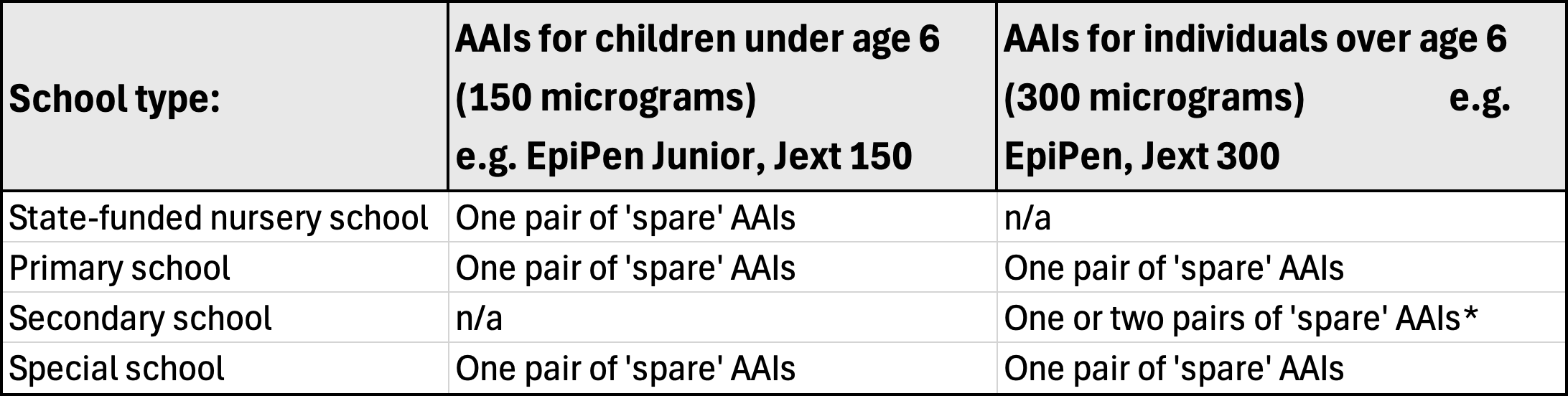
* Secondary schools with larger sites should consider having two pairs of 'spare' AAIs, so that a pair of 'spare' AAIs are available within five minutes of wherever they may be needed.
A member of staff needs to check the integrity of the adrenaline device on a monthly basis to ensure that it remains in date, clear without any particles in it. The checks need to be documented.
Adrenaline devices can be obtained from a range of places with a very wide variation in price. A list of places to obtain devices is available here.
Allergy Action Plans and Individual Healthcare plans
Allergy Action Plan: a medical document that is created by the diagnosing clinician, this may be allergy clinic specialist or GP. These must be signed by parents and include their contact details. These are updated when the student is reviewed in allergy clinic.
Students with Immunoglobulin E food allergies will have an allergy action plan. Students who carry adrenaline for other allergies will have an allergy action plan.
BSACI Paedriatic Allergy Action Plan - EpiPen
Individual Healthcare Plan: a school owned document that is co-created by school and parents. It identifies and details the reasonable adjustments that a student needs in order to keep them safe whilst fully included in the life of the school. These are reviewed annually and should be passed on to a new setting. The new setting must create a new IHP but some of the adaptions may be useful information.
All students with an Allergy Action Plan need an Individual Healthcare Plan. Students with other allergies will need an Individual Healthcare Plan if:
they have an allergy which has a functional impact on them in their school, college or setting
they are at risk of harm as a result of their allergy and
they require arrangements which are additional to or different from those made generally.
A template and example are downloadable from here.
Incidents and near misses
These are a key part of a school’s monitoring and all incidents and near misses must be recorded and reviewed. Schools should ensure that staff are confident in what the difference is between and incident and a near miss. Staff should also know that the reporting of these is welcomed as this forms part of ensuring that the students are safe, procedures are amended when needed to and a no blame culture exists.
School should adapt their usual systems to include recording and reporting of incidents.
The Allergy Lead must review these for lessons learnt and amendment to policy and practice if needed.
Governors should receive information about these on a regular basis, contributing to reviews as needed.
Save time and improve your safeguarding approach…
Bite-size training materials to share with your staff every month.
Support to explore and develop your safeguarding culture.
A huge array of resources and professional experience at your fingertips.
Get in touch now for a personal tour of the site and details of membership benefits.
We look forward to working with you.
Resources
There is a comprehensive range of resources for schools providing everything that a school needs in order to understand their duties and responsibilities under Benedict’s Law plus Allergy Safety in Schools, 2026. Resources that are free to download include:
Model policy that is compliant with Allergy Safety in Schools
Individual healthcare plan template
Individual risk assessments for students
Site risk assessment
Guidance sheets on trips, food in the curriculum and therapy dogs
Allergy management, safeguarding and GDPR
As the leading provider of gold standard allergy training there is compliant eLearning training called AllergyWise® for Schools plus the potential for face-to-face training with student assemblies. Training has a small cost as the charity needs to cover its delivery costs.
Resources are downloadable here. E-Learning from Anaphylaxis UK can be purchased here.
About Anaphylaxis UK
Anaphylaxis UK has been supporting people living with serious allergies as a charity for over 30 years, offering evidence-based, trusted information for individuals and their families, for businesses and for schools helping them navigate the challenges of allergy management with confidence. To learn more about how you can support students living with serious allergies and access practical tools for your educational and childcare settings, contact Anaphylaxis UK:
For information and support for specific questions contact Anaphylaxis UK on: allergywise@anaphylaxis.org.uk or check out the range of resources on the website: www.anaphylaxis.org.uk.
Together, we can create a brighter future for everyone at risk of serious allergies.