

Introduction
Sexism is prejudice or discrimination based on sex. It is attitudes, beliefs, stereotypes, language and behaviours based on a person's sex or on expectations about how people of a particular sex should behave. Sexism often devalues, excludes, stereotypes and causes harm to people because of these assumptions. Sexism can affect people in different ways. It can affect girls and women, boys and men, and people who do not conform to traditional expectations about sex and gender roles. Trans people may also experience discrimination related to gender reassignment or because of their sex.
It would be too simplistic to say there was a direct cause and effect between sexism and its negative impact on children, but sexism could shape the expectations we have of children and potentially normalise and excuse harmful behaviour.
Sexism can also be an influence in parental issues which might cause harm to children, for example domestic abuse and can also be a factor in other safeguarding issues such as violence against women and girls and sexual harassment.
Need more?
Thank you for visiting our resources pages. These are free to everyone as is our fortnightly safeguarding bulletin – general safeguarding information is too important to restrict. Become a member to access lots more, including training materials for you to deliver in-house on each topic in Keeping Children Safe in Education.
Sign up for FREE fortnightly bulletin.
What about training?
We can deliver training for your setting on this and other subjects via online platforms, or face-to-face in certain areas. Just get in touch to discuss your requirements.
Sexism can create the conditions where some children have less power and control over their own experiences and sexism contributes to victim-blaming perspectives where the child who has been harmed is seen as somehow responsible due to the way they behaved or acted. Some boys experience shame and isolation if they don’t conform to ‘stereotypical’ masculinity and such stereotypes might even discourage some boys from seeking help for harm or abuse when they experience this. Every child should be able to feel safe, respected and valued and identifying and addressing sexism is part of a preventative approach to serious harms.
Understanding sexism, misogyny and misandry
Sexism
The Council of Europe uses an internationally agreed definition, describing sexism as acts, words, practices or behaviours based on the idea that a person or group is inferior because of their sex, which can violate rights and dignity, cause harm, create hostile or degrading environments, or reinforce gender stereotypes.
Sexism can lead to and is a part of misogyny and misandry.
Misogyny
The systemic hatred, devaluation, or prejudice against women. It is historically and culturally embedded, often manifesting in restricted opportunities, discrimination, and the perception of women as inferior. It has deep historical roots, influencing laws, social norms, and cultural practices. Examples include restrictions on women’s voting rights, property ownership and participation in public life.
Misandry
The hatred, devaluation, or prejudice against men, which can include negative stereotypes, emotional disdain, or assumptions about male incompetence in domestic or emotional roles. Compared to misogyny, it lacks a comparable historical foundation and is less systematically enforced, though it can arise in response to perceived male dominance or personal negative experiences of males.
Misogyny Awareness: Children and Young People
Our short, introductory e-elearning course raises awareness of misogyny. It helps you to identify misogynistic behaviour in children and young people, and provides support in tackling those behaviours appropriately.
Discrimination based on sex
Sexism and discrimination based on sex are related, but they are not the same thing. Under the Equality Act 2010, sex is a protected characteristic. Following the Supreme Court's 2025 judgement, ‘sex’, ‘man’ and ‘woman’ in the Equality Act refer to biological sex.
The Equality Act also protects people who have the protected characteristic of gender reassignment. These protections are separate from the protected characteristic of sex, although they can sometimes overlap. The Equality and Human Rights Commission has more information about unlawful discrimination and protected characteristics.
Where might sexism be a factor in safeguarding?
Domestic abuse - sexist attitudes can contribute to unhealthy and unequal power dynamics within relationships. Beliefs about who should have control, who should provide or care for others, and what men or women are ‘entitled’ to can be used to explain controlling, coercive or abusive behaviour.
Sexual violence and harassment - sexism can normalise the objectification of others, sexual entitlement and beliefs that someone's boundaries matter less because of their sex. These attitudes can contribute to sexual harassment, coercion and sexual violence, including harmful sexual behaviour between children and young people. Keeping Children Safe in Education specifically highlights the intersection between misogyny and harmful sexual behaviour.
Teenage relationship abuse is abuse in intimate personal relationships between children and it can feature all of the controlling, coercive and abusive behaviour found in domestic abuse. In the UK, the legal definition of domestic abuse is limited to individuals aged 16 or over.
Harmful practices, such as Female Genital Mutilation (FGM) and forced marriage - harmful gender norms and beliefs about roles, behaviour, sexuality and ‘honour’ can underly and maintain harmful practices. Harmful practices can impact both men and women.
Public sexual harassment can include unwanted sexual comments, gestures, staring, following, sexualised remarks or other behaviour intended to intimidate, humiliate or make someone feel unsafe - sexism can contribute to public sexual harassment by normalising sexual entitlement, objectification and the belief that someone’s body, appearance or behaviour is open to comment or judgement. For all children, experiencing or witnessing public sexual harassment can affect their sense of safety, freedom and wellbeing, and can contribute to the further normalisation of harmful attitudes and behaviours.
‘Toxic masculinity’ is a term sometimes used to describe harmful expectations about how men and boys should behave. These can include beliefs that men should always be strong, dominant, aggressive or in control, or that showing vulnerability is a weakness. Such beliefs can reinforce sexism and make it harder for some boys and men to seek help or challenge harmful behaviour.
Violence against women and girls (VAWG) - sexism can create and reinforce the attitudes, stereotypes and unequal power relationships that underpin violence against women and girls. This can include beliefs that women and girls are less worthy of respect, have less autonomy, or should conform to particular roles or expectations.
Child-on-child abuse - Keeping Children Safe in Education explicitly links sexism to harmful sexual behaviour, which can be a form of child-on-child abuse. Teenage relationship abuse, bullying, sexual violence and sexual harassment can all be features of child-on-child abuse.
Prevalence
Whilst there is no definitive way to assess the prevalence of sexism, there is some data collected about issues where sexism could be or is a factor.
In July 2025, the Office for National Statistics looked at figures of domestic abuse, sexual assault and stalking in England and Wales and estimated that in year ending March 2025, 10.6% of people aged 16 years and over were victims of at least one of the crime types of domestic abuse, sexual assault or stalking in the last year (12.8% of women and 8.4% of men)
Statistics from the Forced Marriage Unit (FMU) show that in 2025 they received 1,295 contacts related to a possible forced marriage and/or possible female genital mutilation (FGM). Of the cases in which the FMU provided tailored assistance in 2025, 301 cases (74%) involved female victims and 105 cases (26%) involved male victim
More than 2 in 3 girls and young women have supported another girl or young woman because they may have experienced sexism or misogyny (Girls’ Attitudes Survey 2025, Girlguiding)
Spot the signs
The impact of sexism on children doesn’t have a distinct set of indicators but potential indicators might include:
Changes in behaviour, attendance, engagement, attainment or mood.
Low self-esteem or negative beliefs about themselves, particularly where these appear connected to their sex, gender, appearance, body or perceived role.
Expressing overly rigid gender-stereotypical beliefs about themselves or others.
Sexist, misogynistic or misandrist language or behaviour, for example using degrading, hostile or stereotypical language towards others, or expressing beliefs that one sex or gender is inferior, less deserving of respect or entitled to control another.
Sexualised language, behaviour or online activity. This might include objectification or behaviour that disregards another person's boundaries.
Fear, avoidance or changes in relationships.
Controlling or coercive behaviour in relationships. This might be a child either experiencing or enacting behaviours such as monitoring, controlling who someone sees, demanding access to phones or social media, restricting activities or using threats.
Concerns about bodily autonomy or reproductive control. A child might say or suggest there has been some pressure or coercion relating to their or someone else’s body, sexual activity, pregnancy, contraception or reproductive choices.
Signs of pressure relating to gender, sexuality, relationships or ‘honour’, including fear of bringing shame on a family or community, pressure to conform to expected roles, or concerns about marriage or other harmful practices.
Changes in how a child understands safety, relationships or their own worth, particularly where they appear to have internalised messages that their sex or gender makes them less worthy of respect, less entitled to boundaries, or responsible for other people's behaviour.
Remember that there is no single pattern of behaviour that indicates a child is being affected by sexism. Children may respond to harmful attitudes, harassment, abuse or gender-based expectations in very different ways. It might also be that sexism has been a factor in one of the other harms and abuses described above, therefore it might be signs and indicators of those things that you see.
What to do
Create a culture based on equality and informed choice. Settings are well placed to help by:
Resisting assumptions by pausing and considering whether anyone has pre-conceived ideas about a child because they are a boy or girl, or because they do not conform to traditional expectations about how boys and girls should behave.
Challenging gender stereotypes and giving children opportunities to develop and express themselves beyond traditional gender expectations.
Paying attention to the words, jokes and phrases used in the setting and whether they reinforce ideas about how boys, girls or other children "should" behave.
Giving children equal voice and opportunity by noticing who gets your attention, who is interrupted, whose behaviour is challenged and whose ideas are taken seriously.
Never excusing harmful behaviour. Address behaviour swiftly and consider what might be behind it.
Addressing sexism when it is seen and considering whether a pattern of behaviour raises a safeguarding concern.
Keeping the child at the centre by getting to know their individual circumstances, experiences or needs.
Check children and young people have safe relationships – in their family, with their peers and with your staff. Create a culture where it’s okay to talk even about the most difficult things.
Know the signs of potential harm and know what to do – use the checklists above, your safeguarding procedures and be confident in raising sexism as a concern.
Take action – and keep taking action until you know children and young people are safe.
Building partnerships with parents and carers
When working with parents and carers, practitioners should prioritise a child-centred approach, fostering partnerships to ensure understanding, support and safety.
Remember:
Collaborative efforts are crucial, especially in cases of suspected harm.
Practitioners must engage effectively with diverse families, demonstrating empathy, respect and cultural awareness.
Communication should be clear, inclusive and accessible. Encouraging parental/carer involvement in decision-making and valuing their input is essential.
Involving families and communities in designing processes fosters a holistic approach to safeguarding children.
Continuous reflection and adaptation based on feedback from parents and carers enhance practice effectiveness.
Have you considered if:
* parents and carers need more support to understand the issue sexism and the areas of risk where sexism might be a factor in safeguarding their children?
* there are enough places and spaces where parents and carers from marginalised groups can seek informal advice and support from the setting?
* the signposting and information regarding things like domestic abuse, sexual violence, sexual harassment are accessible to all families, with consideration given to language, literacy, learning needs?
Free gender-based violence poster
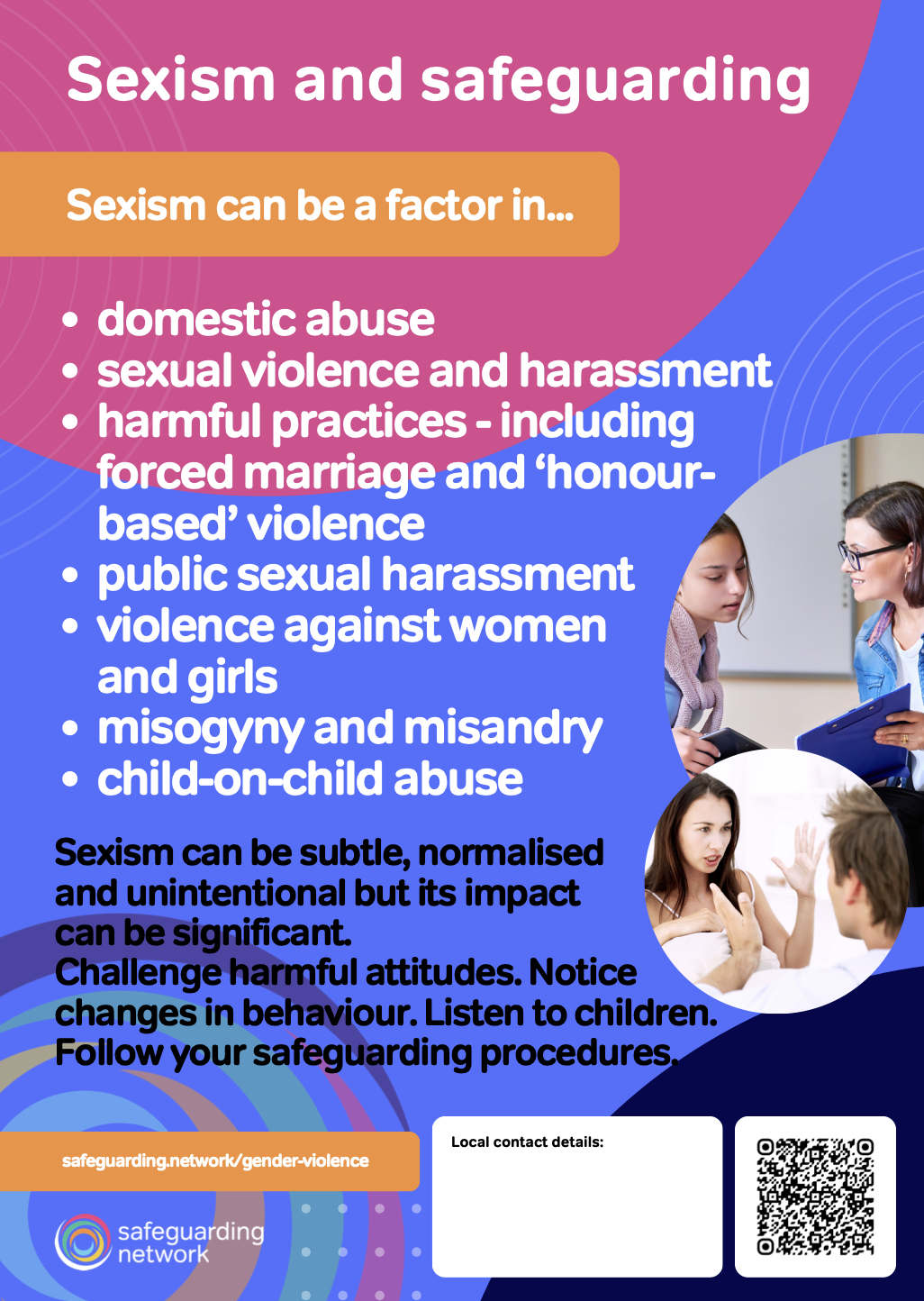
This free, downloadable resource raises the profile of safeguarding for your staff team. For use in staff rooms, on safeguarding boards or on the back of toilet doors, the poster includes tips, a space for local contact details, plus a link and QR codes to this resource page. Download the poster from the resources below.
DSL Training Materials
-

Sexism and Safeguarding Presentation
-
Sexism and Safeguarding - Presenter Notes
-
Handout for staff - Sexism and safeguarding
-
Sexism and Safeguarding Quiz
-
Sexism and Safeguarding Quiz (answer sheet)
-
Sexism and Safeguarding Scenario – Early years settings
-
Sexism and Safeguarding Scenario – Early Years settings – DSL Information Sheet
-
Sexism and Safeguarding Scenario (primary schools)
-
Sexism and Safeguarding scenario (primary schools) – DSL information sheet
-
Sexism and Safeguarding scenario (secondary schools)
-
Sexism and Safeguarding scenario (secondary schools) – DSL information sheet
-
Sexism and Safeguarding scenario – 16+ settings
-
Sexism and Safeguarding scenario – 16+ settings – DSL Information Sheet
-
Sexism and Safeguarding scenario – SEND Settings
-
Sexism and Safeguarding scenario – SEND Settings – DSL Information Sheet
-
Sexism and Safeguarding scenario – care settings
-
Sexism and Safeguarding scenario – Care settings – DSL Information Sheet
Resources
-
Sexism and safeguarding poster
-

Netflix's Adolescence - Empowering the safeguarding discussion
-
What does gender equality mean to your pupils?
-
Addressing toxic masculinity, misogyny and social media influence
-
Appropriate Language Guide
-
Homophobic, biphobic and transphobic bullying
-
Responding to the incel ideology
Save time and improve your safeguarding approach…
Bite-size training materials to share with your staff every month.
Support to explore and develop your safeguarding culture.
A huge array of resources and professional experience at your fingertips.
Get in touch now for a personal tour of the site and details of membership benefits.
We look forward to working with you.