
Improving help and child protection: revised framework - what education settings need to know
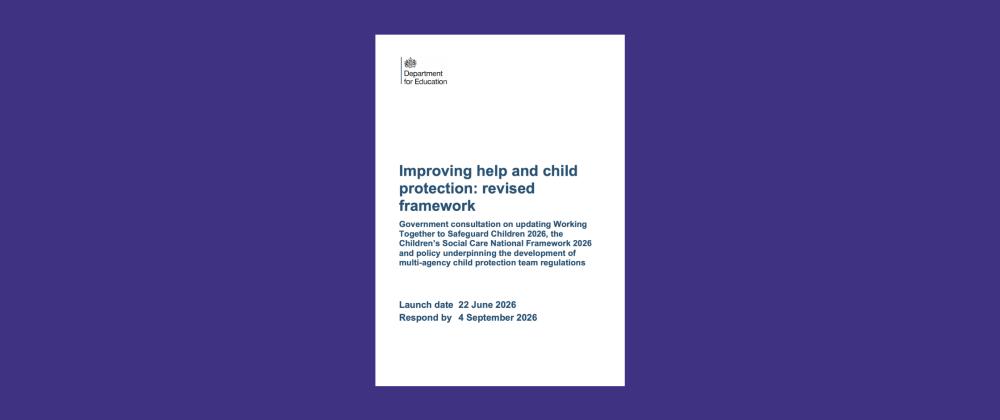
The DfE have just launched an open consultation on ‘Improving help and child protection: revised framework’. The consultation is looking at 3 areas which are vital to how Children’s Social Care is enacted across England: the Working Together to Safeguard Children, the Children’s Social Care National Framework and the Multi-Agency Child Protection Team (MACPT) regulations. This is all in the context of changes already created by the Children’s Wellbeing and Schools Act.
Whilst the consultation is underway, let’s look at what education settings need to know about the planned changes – because this is going to impact much more than how Children’s Social Care practice.
1. Education becomes a safeguarding ‘partner in practice’
The most significant system change is that the Children’s Wellbeing and Schools Act automatically brings education and childcare settings into local multi-agency safeguarding arrangements (MASA), rather than relying on local safeguarding partners choosing how to involve education.
2. Multi-Agency Child Protection Teams (MACPTs)
The multi-agency child protection teams should contain social work, police, health and education expertise. The policy paper proposes that every MACPT must include a person with education experience and highlights DSL-level expertise as the model. DSLs in settings will need to understand MACPT decision-making routes, referral thresholds, conference arrangements and escalation routes.
3. Schools may be required to enter formal cooperation arrangements with MACPTs
The regulation-making proposals specifically identify schools, FE providers, PRUs and alternative provision as agencies that could be required to enter cooperation memoranda with safeguarding partners about things like information sharing, attendance data, professional challenge and response times. Some local safeguarding expectations that are currently good practice may become much more structured and enforceable.
4. Stronger information-sharing expectations
The consultation confirms implementation of the new Information Sharing Duty contained in the Children’s Wellbeing and Schools Act and indicates that Working Together will be updated accordingly. All those named in Section 11 of the Children Act 2004 and Working Together to Safeguard Children should expect a lower tolerance of information-sharing delays and greater scrutiny of safeguarding recording.
5. Greater emphasis on the voice of children
The consultation proposes stronger requirements for safeguarding partnerships to demonstrate how children's lived experience directly influences decision-making and how services are reviewed and improved. Education settings may need to stronger evidence things like how children are being heard, how their voice influences safeguarding planning and how vulnerable groups in the setting are represented. This aligns closely with current Ofsted thinking.
6. Family Help becomes even more central
As we know, Working Together to Safeguard Children 2026 and the Children’s Social Care National Framework already position Family Help as the primary integrated support model. Education settings will likely need to participate more actively in Family Help planning, contribute earlier to family assessments and support whole-family approaches.
8. Family Group Decision Making (FGDM)
The consultation builds on legislative changes requiring families to be offered Family Group Decision Making. Education settings might be asked to contribute reports to FGDM meetings, support family-led plans and engage with wider family networks rather than only parents.
8. Focus on extra-familial harm and exploitation
The consultation specifically seeks to strengthen the response to extra-familial harm, child sexual exploitation, criminal exploitation and extreme violence. Across the multi-agency work we should expect broader extra-familial harm safeguarding expectations, increased emphasis on peer groups, locations and networks, more disruption activity and greater focus on exploitation indicators before exploitation is occurring.
9. Safeguarding partnerships will become more accountable and evidence-driven
The consultation proposes stronger independent scrutiny with clear challenge and escalation processes, supported by robust annual reporting. Education settings might experience more scrutiny of their safeguarding partnership contributions with greater expectation of evidenced impact.
Safeguarding Network will watch these developments closely and keep you updated.
Sign up for our free safeguarding Bulletin
Interested in membership?
Join over 3,500 DSLs and nearly 40,000 staff in 1,500 education settings receiving high value support, consultancy and the tools you need to keep the children in your care safe.
Basket
Your basket is empty
Add a course or resource, then return here to checkout.